
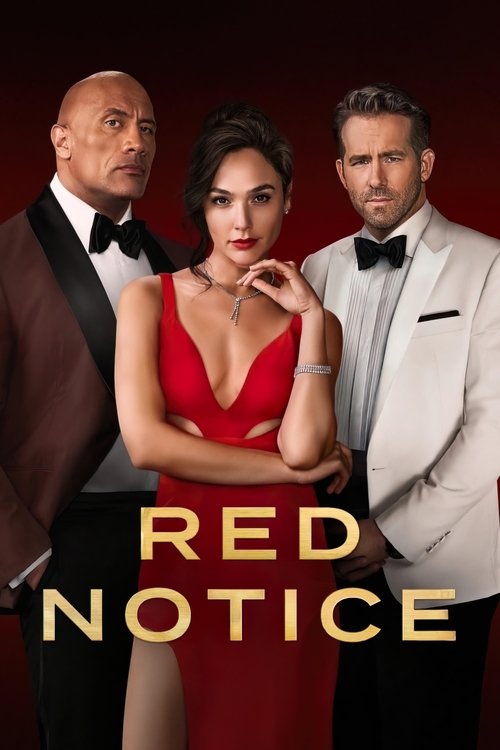
Red Notice
Pro and cons.
Red Notice — Plot
An Interpol-issued Red Notice is a global alert to hunt and capture the world's most wanted. But when a daring heist brings together the FBI's top profiler and two rival criminals, there's no telling what will happen.
Red Notice — Cast
Community rating
Rating distribution
- 3 watched
- 0 watching
- 0 watchlist
- 0 dropped
- 0 likes
Characters
Rate the cast one by one. The best-loved character is the community’s call.
 John HartleyDwayne JohnsonNo ratings yet
 Nolan BoothRyan ReynoldsNo ratings yet
 Sarah Black / The BishopGal GadotNo ratings yet
 Inspector Urvashi DasRitu AryaNo ratings yet
 Sotto VoceChris DiamantopoulosNo ratings yet
 TambweIvan MbakopNo ratings yet
 Director GalloVincenzo AmatoNo ratings yet
 Security Chief RicciRafael PetardiNo ratings yet
 Souvenir Stand OwnerSeth MichaelsNo ratings yet
- Gelato Truck DriverSebastien LargeNo ratings yet
 Museum Reporter / Italian VIPGuy NardulliNo ratings yet
 Moped TouristAndrew HunterNo ratings yet
 Bali Van DriverGeorge TsaiNo ratings yet
 Exhausted Film Director in BarRawson Marshall ThurberNo ratings yet
- Handsome BartenderRobert MataNo ratings yet
 Prison Guard SergeantAnthony BelevtsovNo ratings yet
 Drago GrandeDaniel BernhardtNo ratings yet
- Lead GuardYosef PodolskiNo ratings yet
 Tower GuardMartin HarrisNo ratings yet
 Intelligence AnalystAlexander PerkinsNo ratings yet
 Old TechJoseph A. GarciaNo ratings yet
- Head WaiterGonzalo EscuderoNo ratings yet
- Sotto Vocce Display Room GuardJay RomeroNo ratings yet
 Aranoub MagdyEthan HerschenfeldNo ratings yet
Sign in to rate characters.
Where to watch
Subscription
 Netflix
 Netflix Standard with Ads
Reviews
-
There comes a point where an industry ceases to make movies and simply starts packaging diversified assets to satisfy algorithmic quarterly targets. I had intentionally avoided writing down my thoughts on this piece of content for several months after sitting through it, largely because the immediate frustration felt too ephemeral to warrant serious critical engagement. Yet looking back at my viewing notes tonight, after another long week dealing with corporate optimization models, the parallels between streamlined corporate restructuring and this exact kind of filmmaking are too glaring to ignore. What we have here is not cinema in any traditional sense, but an automated consumer delivery mechanism engineered to be played in the background while someone scrolls on their phone. From the opening minutes, the visual architecture reveals an alarming aesthetic poverty. Every frame feels suffocated by the synthetic glaze of soundstage digital capture, where dynamic lighting and authentic depth of field are abandoned in favor of an evenly lit, hyper-saturated digital mush. It is impossible to ignore how completely detached the actors look from their environments. Whether the narrative claims to be in Rome, a Russian gulag, or a South American jungle, the spatial reality never shifts beyond a couple of sterile volume stages with aggressive post-production color grading painted over the cracks. Contrast this with the kinetic geography of a master like Spielberg or the razor-sharp tactile environments David Fincher constructs with digital tools, where visual weight and tangible space dictate how the viewer processes tension. Here, physical space simply does not exist. The camera glides around on frictionless digital tracks, unbound by any law of physics or human perspective, rendering every action set piece entirely devoid of stakes. Then there is the central star trio, functioning less as dramatic characters and more as brand ambassadors aggressively guarding their respective intellectual properties. Ryan Reynolds delivers the exact same meta-quipping, deadpan neurotic routine he has recycled across half a dozen properties, completely indifferent to tonal discipline or situational urgency. Dwayne Johnson operates strictly within the narrow parameters of his meticulously curated public persona, refusing to show genuine vulnerability or physical fallibility. Gal Gadot glides through scenes flashing polished smiles and delivering wooden dialogue with the cadence of someone reading teleprompter cues at an awards gala. There is zero friction between them, no dynamic push and pull, no underlying spark of authentic charisma. Instead, we get a sterile exchange of pre-packaged banter where every one-liner lands with the hollow thud of a focus-grouped focus point. Structurally, the project lacks narrative discipline from top to bottom. Director Rawson Marshall Thurber constructs a caper that borrows indiscriminately from superior cinematic archetypes without grasping what made those forebears tick. A great heist film relies on meticulous planning, clear causal chains, spatial logic, and the palpable sensation of time running out. In this production, plot mechanics are resolved through convenient hand-waves and unearned narrative pivots designed solely to shuffle the actors to the next digital backdrop. Steve Jablonsky turns in an orchestral score that labors exhaustingly to inject adrenaline into sequences that possess no inherent rhythm of their own, resulting in an experience that is tonally incoherent and relentlessly noisy without ever becoming exciting. By the time the climax arrives, the narrative has collapsed under the weight of its own cynicism. The film mistakes superficial plot contrivances for cleverness and celebrity proximity for dramatic chemistry. It is a textbook derivative corporate exercise, devoid of human texture, authored voice, or any genuine respect for the medium of moving pictures. When a multi-million-dollar production treats its own audience with this degree of calculated indifference, treating cinema not as an art form built on light and choreography but as an algorithmic spreadsheet meant to inflate engagement metrics, it deserves to be called out for what it is. A profoundly dispiriting, glossy void that evaporates from memory the second the credits roll.
Similar Films
If you liked Red Notice, these are worth a look.


